Submitted by Kuzin
Sighting title and description hidden: turn on “Show spoilers” above to read them.88%into film
RatGraphic / disturbingApprox. 10 rats
1984 · 113 min · R
1 sighting contain spoilers
Titles, descriptions, and images are hidden until you reveal them.
Submitted by Kuzin
Sighting title and description hidden: turn on “Show spoilers” above to read them.88%into film
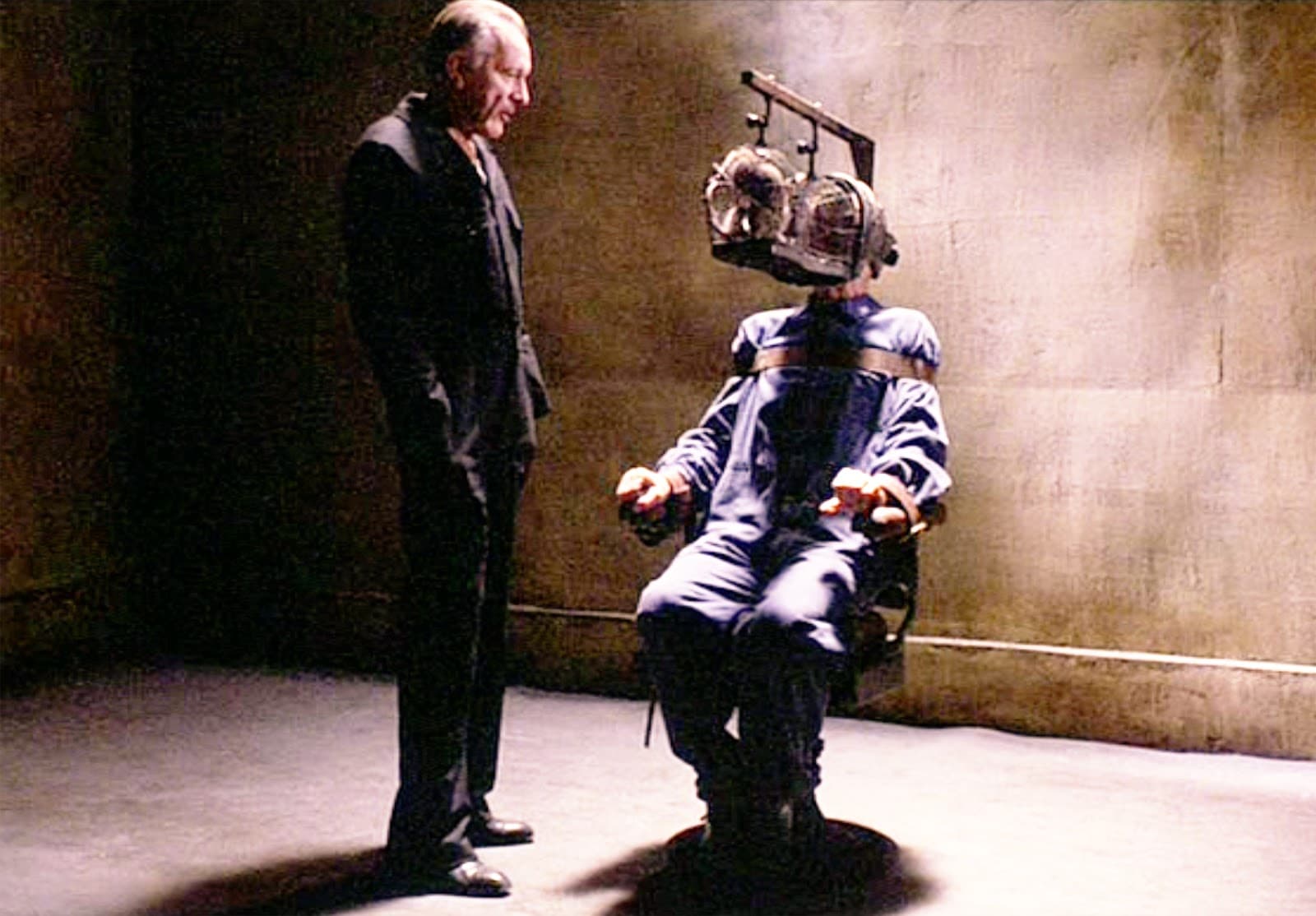
RatGraphic / disturbingApprox. 10 ratsThe tortures that Winston endures in the Ministry of Love evoke the procedures used by the Soviet N.K.V.D. in their interrogations, which included beatings by the use of rubber truncheons, being forbidden to put your hands in your pockets, remaining in brightly-lit rooms for days, torture through the use of provoked rodents, and the victim being shown a mirror after their physical collapse.
Michael Radford had members of the crew go down into the sewers and get real sewer rats that were used in the film.
A Slow but Powerful Dystopian Film
1984 is a dark and unsettling film that effectively captures the oppressive atmosphere of George Orwell's novel. John Hurt gives a strong, believable performance, and the bleak visuals reinforce themes of control and surveillance. While the pacing is slow and the film can feel emotionally distant at times, it remains powerful and relevant. A thoughtful watch for fans of dystopian cinema.
A Hollow Echo of Orwell's Vision
I/ Plot & Screenplay The film follows the book's plot closely, and therefore carries the same issues I found in the novel. The love story between Winston and Julia is rushed (not to say "botched"), and O'Brien's introduction in the film really didn't convince me. The narrative strengths of the book are not optimized in the movie. The presentation of the totalitarian system feels sloppy, and if you haven't read the book, you'll likely struggle to follow what's happening in an enjoyable way. The film fails to present the book's strong ideas with the same power, making its weaknesses even more obvious. II/ Characters & Performance John Hurt and Suzanna Hamilton are excellent in their roles as Winston and Julia respectively, especially physically, even though at times the acting feels a bit weak. It's not their fault-I choose to believe it was Michael Radford's direction. Still, there were moments in the film where it bothered me. III/ Visuals & Direction The visuals are outstanding: the sets, the costumes, the makeup, the scenes-this is the film's strongest point. They succeed perfectly in conveying this apocalyptic totalitarian world, creating exactly the discomfort required. The framing and editing choices, on the other hand, are weak, and this flaw weighs twice as much because in a film adapting a book with so little dialogue, it's essential to be able to tell the story through images alone-their composition, their changes, their movements. This missed opportunity creates an awkwardness in the final product and makes the film hard to digest if you haven't read the book. IV/ Overall Impact & Message In my opinion, the film cannot live without the book. What I mean is that it brings no added value to someone who has already read the novel, and someone who hasn't may spend more time wondering what is happening than appreciating the theme. The book is like a fictionalized manifesto showing the danger of totalitarian systems-their strengths, their methods, and what could happen to you if you rebel. The film is just an awkward love story in a post-apocalyptic world. Ingsoc isn't the main theme; it's merely the background of Winston's life.
Read more ↓I/ Plot & Screenplay The film follows the book's plot closely, and therefore carries the same issues I found in the novel. The love story between Winston and Julia is rushed (not to say "botched"), and O'Brien's introduction in the film really didn't convince me. The narrative strengths of the book are not optimized in the movie. The presentation of the totalitarian system feels sloppy, and if you haven't read the book, you'll likely struggle to follow what's happening in an enjoyable way. The film fails to present the book's strong ideas with the same power, making its weaknesses even more obvious. II/ Characters & Performance John Hurt and Suzanna Hamilton are excellent in their roles as Winston and Julia respectively, especially physically, even though at times the acting feels a bit weak. It's not their fault-I choose to believe it was Michael Radford's direction. Still, there were moments in the film where it bothered me. III/ Visuals & Direction The visuals are outstanding: the sets, the costumes, the makeup, the scenes-this is the film's strongest point. They succeed perfectly in conveying this apocalyptic totalitarian world, creating exactly the discomfort required. The framing and editing choices, on the other hand, are weak, and this flaw weighs twice as much because in a film adapting a book with so little dialogue, it's essential to be able to tell the story through images alone-their composition, their changes, their movements. This missed opportunity creates an awkwardness in the final product and makes the film hard to digest if you haven't read the book. IV/ Overall Impact & Message In my opinion, the film cannot live without the book. What I mean is that it brings no added value to someone who has already read the novel, and someone who hasn't may spend more time wondering what is happening than appreciating the theme. The book is like a fictionalized manifesto showing the danger of totalitarian systems-their strengths, their methods, and what could happen to you if you rebel. The film is just an awkward love story in a post-apocalyptic world. Ingsoc isn't the main theme; it's merely the background of Winston's life.
Show less ↑Oh so close
My review will echo others' in that I loved the book but the film needs another half an hour or so to build the story and add depth. The cast is brilliant. John Hurt is perfect as Smith and Richard Burton likewise as O'Brien. Suzanna Hamilton also makes a very convincing Julia. I watched this with my wife, who had not read the book, and I wondered if she got what was going on. Answer "not really" as the film didn't build the necessary context. Who was O'Brien? What did Smith do as a job? What are the hate rallies about? Who was Charrington? I know the answers to that list but, without having read the book, it's not clear to me that the new viewer fully gets it. One striking part of the book to me is part two where Smith and Julia have been detained. The initial prison scenes before we get to room 101 are a gruelling read. Maybe just another 5 minutes in the film around this aspect would have added much more. So, as someone who has read the book a few times, I liked the movie and filled in the blanks in my head, but as a standalone work it just needs that little bit more.
Read more ↓My review will echo others' in that I loved the book but the film needs another half an hour or so to build the story and add depth. The cast is brilliant. John Hurt is perfect as Smith and Richard Burton likewise as O'Brien. Suzanna Hamilton also makes a very convincing Julia. I watched this with my wife, who had not read the book, and I wondered if she got what was going on. Answer "not really" as the film didn't build the necessary context. Who was O'Brien? What did Smith do as a job? What are the hate rallies about? Who was Charrington? I know the answers to that list but, without having read the book, it's not clear to me that the new viewer fully gets it. One striking part of the book to me is part two where Smith and Julia have been detained. The initial prison scenes before we get to room 101 are a gruelling read. Maybe just another 5 minutes in the film around this aspect would have added much more. So, as someone who has read the book a few times, I liked the movie and filled in the blanks in my head, but as a standalone work it just needs that little bit more.
Show less ↑Very faithful adaptation, but not quite as good as the novel
Even though it's not as good as George Orwell's iconic novel, this film version of 1984 definitely stays true to the tone and message. It really nails that dystopian athmosphere with its fantastic grim and gray visuals. John Hurt is solid as always although I feel like he's a bit miscast as Winston Smith here, while Richard Burton gives a great and really intense performance as O'Brien in his final role. That said, the movie feels rather slow and emotionally distant. It captures the despair, but almost a bit too well. The pacing also drags quite a bit at times (especially in the first two acts). Overall, a solid and faithful adaptation, just not a particularly thrilling one.
Read more ↓Even though it's not as good as George Orwell's iconic novel, this film version of 1984 definitely stays true to the tone and message. It really nails that dystopian athmosphere with its fantastic grim and gray visuals. John Hurt is solid as always although I feel like he's a bit miscast as Winston Smith here, while Richard Burton gives a great and really intense performance as O'Brien in his final role. That said, the movie feels rather slow and emotionally distant. It captures the despair, but almost a bit too well. The pacing also drags quite a bit at times (especially in the first two acts). Overall, a solid and faithful adaptation, just not a particularly thrilling one.
Show less ↑
Nineteen Eighty-Four
This adaptation is a fairly faithful, if a little too abridged, version of the Orwellian story of absolute power, sedition and oppression but it's really John Hurt who makes this version stand out. His performance as the weedy "Winston" - a low level bureaucrat in the Ministry of Truth, is visceral as he depicts a character who has found his own way to rebel against the not so benevolent rule of "Big Brother". Everything they do, say - even think, is being monitored and so his life is conceivably now in considerable danger. That is only likely to increase after he encounters the like-minded "Julia" (Suzanna Hamilton) and together they begin to think the unthinkable! Richard Burton starts to make his presence felt around half way though with his perfectly pitched vocal tones and even more measured delivery creating a sense of torturous menace that you could cut with a knife, and though he features quite sparingly his contributions when the two are together put an whole new meaning on cat and mouse. It's a brutal watch, both physically and psychologically and the use of militaristic archive and the simplicity of it's own production help give this an edge that's gritty and philosophically quite savage as we head even deeper into a society controlled by machines, tyrants and indifference almost eighty years after it was written. It's bleak!
Read more ↓This adaptation is a fairly faithful, if a little too abridged, version of the Orwellian story of absolute power, sedition and oppression but it's really John Hurt who makes this version stand out. His performance as the weedy "Winston" - a low level bureaucrat in the Ministry of Truth, is visceral as he depicts a character who has found his own way to rebel against the not so benevolent rule of "Big Brother". Everything they do, say - even think, is being monitored and so his life is conceivably now in considerable danger. That is only likely to increase after he encounters the like-minded "Julia" (Suzanna Hamilton) and together they begin to think the unthinkable! Richard Burton starts to make his presence felt around half way though with his perfectly pitched vocal tones and even more measured delivery creating a sense of torturous menace that you could cut with a knife, and though he features quite sparingly his contributions when the two are together put an whole new meaning on cat and mouse. It's a brutal watch, both physically and psychologically and the use of militaristic archive and the simplicity of it's own production help give this an edge that's gritty and philosophically quite savage as we head even deeper into a society controlled by machines, tyrants and indifference almost eighty years after it was written. It's bleak!
Show less ↑Simply doesn't have the impact of the book
Orwell's 1984 is a stunning novel. Radford's 1984 is a rather average film. There are a few successes. Visually, it manages to capture a run-down nation that has barely progressed for decades, with well chosen locations, and cinematography that succeeds in being washed-out without resorting to darkness (modern filmmakers take note). Later scenes between Hurt and Burton are taut and powerful. Even though you get the feeling that Burton had done very little to learn his lines, his presence and delivery more than compensate - he is well cast as O'Brien. But Hurt is not a great Winston Smith. Smith is a dreamer, but Hurt doesn't capture that. His relationship with Suzanna Hamilton's Julia doesn't convince as a result. The pacing of the first two acts is slow. And I do wonder whether someone who hasn't already read the book would find it had to engage with the film at all. It's just a bit flat.
Read more ↓Orwell's 1984 is a stunning novel. Radford's 1984 is a rather average film. There are a few successes. Visually, it manages to capture a run-down nation that has barely progressed for decades, with well chosen locations, and cinematography that succeeds in being washed-out without resorting to darkness (modern filmmakers take note). Later scenes between Hurt and Burton are taut and powerful. Even though you get the feeling that Burton had done very little to learn his lines, his presence and delivery more than compensate - he is well cast as O'Brien. But Hurt is not a great Winston Smith. Smith is a dreamer, but Hurt doesn't capture that. His relationship with Suzanna Hamilton's Julia doesn't convince as a result. The pacing of the first two acts is slow. And I do wonder whether someone who hasn't already read the book would find it had to engage with the film at all. It's just a bit flat.
Show less ↑You never know who's watching.
"Looks like meat, tastes like meat, isn't meat at all." In a dystopian future where the authorities have total control over every aspect of human life, Winston Smith begins to document his thoughts and falls in love. His obsession forces him to take risks, endangering both himself and Julia. This is a remarkably faithful adaptation. I'm in the middle of rereading the book, and I'm staggered by just how accurate the film is. Intensely bleak, it presents a nightmare scenario that feels almost prophetic, especially in recent years as freedoms and civil liberties are eroded. Not that I'm a cynic, but glimpses of Orwell's world are eerily present in day-to-day life. The visuals are perfect - exactly what I imagine when reading the novel. The greyness, the squalor, the production design - all on point. What the book does so alarmingly well is create a complete world: rules, ideas, culture, ideals, even a sense of smell and touch. The film manages to capture all of this. The propaganda elements work brilliantly. Posters, screens, voices - it's easy to imagine someone shouting "you've never had it so good." John Hurt is extraordinary, delivering a captivating and sincere performance. Suzanne Hamilton is excellent, and Richard Burton's presence and voice are unforgettable, despite reported issues with the script. This film still gives me chills. 9/10.
Read more ↓"Looks like meat, tastes like meat, isn't meat at all." In a dystopian future where the authorities have total control over every aspect of human life, Winston Smith begins to document his thoughts and falls in love. His obsession forces him to take risks, endangering both himself and Julia. This is a remarkably faithful adaptation. I'm in the middle of rereading the book, and I'm staggered by just how accurate the film is. Intensely bleak, it presents a nightmare scenario that feels almost prophetic, especially in recent years as freedoms and civil liberties are eroded. Not that I'm a cynic, but glimpses of Orwell's world are eerily present in day-to-day life. The visuals are perfect - exactly what I imagine when reading the novel. The greyness, the squalor, the production design - all on point. What the book does so alarmingly well is create a complete world: rules, ideas, culture, ideals, even a sense of smell and touch. The film manages to capture all of this. The propaganda elements work brilliantly. Posters, screens, voices - it's easy to imagine someone shouting "you've never had it so good." John Hurt is extraordinary, delivering a captivating and sincere performance. Suzanne Hamilton is excellent, and Richard Burton's presence and voice are unforgettable, despite reported issues with the script. This film still gives me chills. 9/10.
Show less ↑A well made tip of the hat to those who read the book
This is a very well made movie the acting and atmosphere especially. This film is also very loyal to the book. The thing is it felt like you have had to read the book in order to get much needed context. The book put much much effort in world building as well as Winston's thoughts. In large both are missing here (partially limited by a movies run time I suppose), so many of the scenes greatly lose impact or straight up leave many questions to the viewer who hasn't read the book. Also, to me at least the missing information made the story feel like it is moving in fast forward. So the pacing felt a bit weird to me. Personally I enjoyed the film because it put the world and story outside my head. Making me visually look at this twisted world and also experience it from a perspective that's not mine. Which was really interesting. For these reasons I would recommend all people who read the book watch this movie but definitely not to people who haven't read the book.
Read more ↓This is a very well made movie the acting and atmosphere especially. This film is also very loyal to the book. The thing is it felt like you have had to read the book in order to get much needed context. The book put much much effort in world building as well as Winston's thoughts. In large both are missing here (partially limited by a movies run time I suppose), so many of the scenes greatly lose impact or straight up leave many questions to the viewer who hasn't read the book. Also, to me at least the missing information made the story feel like it is moving in fast forward. So the pacing felt a bit weird to me. Personally I enjoyed the film because it put the world and story outside my head. Making me visually look at this twisted world and also experience it from a perspective that's not mine. Which was really interesting. For these reasons I would recommend all people who read the book watch this movie but definitely not to people who haven't read the book.
Show less ↑A Forecast of the Past, Present & Future...
Winston Smith is bound inside a cage, he's upset all of the folks that pay his wage, by not dancing to the tune, of the Oceania goon, and ignoring all his righteous propaganda. To begin with, he's not thinking as he should, his maths is very poor, and that's not good, plus he's finding lots of time, to commit a sexual crime, by taking his young love into the woods. But Big Brother has a way that he can smother, and O'Brien is a rather vengeful mother, observation sets the trap, then you're caught like a starved rat, and there's nowhere you can run, or look for cover. Just imagine if your world was always seen, there were cameras to report where you had been, a device always recording, what you say, knows what you're hoarding, you spend your time with it just looking at its screen. God forbid!
Read more ↓Winston Smith is bound inside a cage, he's upset all of the folks that pay his wage, by not dancing to the tune, of the Oceania goon, and ignoring all his righteous propaganda. To begin with, he's not thinking as he should, his maths is very poor, and that's not good, plus he's finding lots of time, to commit a sexual crime, by taking his young love into the woods. But Big Brother has a way that he can smother, and O'Brien is a rather vengeful mother, observation sets the trap, then you're caught like a starved rat, and there's nowhere you can run, or look for cover. Just imagine if your world was always seen, there were cameras to report where you had been, a device always recording, what you say, knows what you're hoarding, you spend your time with it just looking at its screen. God forbid!
Show less ↑Disturbing, to say the last
Yes it is very disturbing. But the filmmakers did a great job of showing the eerieness of a nightmarish dystopian future. John hurt and Richard burton give very good performances.
Understands Human Nature
You can see the ideas of this property coming to life each day. Not the dictatorship but the revisionism of the past we do to fit narratives. Hopefully we are not screwed like Winston is.
chillingly brutal in its depiction of a disturbing dystopia
This brilliant adaptation of George Orwell's immoral classic of the same name nearly matches its source material in terms of quality (which is quite the achievement, considering the fact that "1984" is by far one of the greatest novels I have ever read). The chilling direction and pitch perfect performances help make this disturbing vision all the more of a truthful gut punch. The fact that such a hard hitting and seemingly over the top story remains entirely relevant in today's chaotic political climate is both a disgrace and a testament to Orwell's genius, and the cinematic capturing of Orwell's classic is one of practically unbeatable quality. While little to nothing is added to the plot, the visual accompaniment of the story enhances its impact. The cinematography is fittingly dull, soaked entirely of the joys o color. The performances are simply perfect, making this one of the few novel adaptations I have seen in which I felt that the actors absolutely nailed their performing of the original work's dialogue. At the center of this terrifying satire is the performance of Richard Burton who is both subtle and mind blowingly horrifying in his indescribably villainous role, while John Hurt provides a sometimes timid, sometimes paranoid, and other times absolutely petrified protagonist that attempts to escape from the norms of the totalitarian society he is forced to live in. While not necessarily a "horror" movie, there is no doubt that "1984" is among the most genuinely SCARY films that I have ever seen. Both the book and film have succeeded in making me shake like drug addicted pepper and salt shakers. The dystopia depicted here accurately displays the horror of an overly controlling and oppressive government system forcing its propaganda upon those below, and outwardly embracing anti-free speech and pro-war beliefs. I must restate how sadly relevant this work remains.
Read more ↓This brilliant adaptation of George Orwell's immoral classic of the same name nearly matches its source material in terms of quality (which is quite the achievement, considering the fact that "1984" is by far one of the greatest novels I have ever read). The chilling direction and pitch perfect performances help make this disturbing vision all the more of a truthful gut punch. The fact that such a hard hitting and seemingly over the top story remains entirely relevant in today's chaotic political climate is both a disgrace and a testament to Orwell's genius, and the cinematic capturing of Orwell's classic is one of practically unbeatable quality. While little to nothing is added to the plot, the visual accompaniment of the story enhances its impact. The cinematography is fittingly dull, soaked entirely of the joys o color. The performances are simply perfect, making this one of the few novel adaptations I have seen in which I felt that the actors absolutely nailed their performing of the original work's dialogue. At the center of this terrifying satire is the performance of Richard Burton who is both subtle and mind blowingly horrifying in his indescribably villainous role, while John Hurt provides a sometimes timid, sometimes paranoid, and other times absolutely petrified protagonist that attempts to escape from the norms of the totalitarian society he is forced to live in. While not necessarily a "horror" movie, there is no doubt that "1984" is among the most genuinely SCARY films that I have ever seen. Both the book and film have succeeded in making me shake like drug addicted pepper and salt shakers. The dystopia depicted here accurately displays the horror of an overly controlling and oppressive government system forcing its propaganda upon those below, and outwardly embracing anti-free speech and pro-war beliefs. I must restate how sadly relevant this work remains.
Show less ↑A Directorial Success But Not A Narrative One
George Orwell's 1984 is one of the most celebrated novels of the 20th Century . We have words like " Orwellian " that have come in to everyday modern usage . Indeed there's at least two television shows BIG BROTHER and ROOM 101 who take their concepts from 1984 . It seems logical that if someone was going to make a film adaptation of the novel then 1984 would be the perfect year to release it . Unfortunately Michael Radford's interpretation of Orwell is an irritating clash between the good and the bad Radford's visuals are superb and the tone sets the dark , gloomy , downbeat feel of the novel perfectly . Orwell used Stalin's Soviet Union for much of the novel's inspiration as well as 1940s Britain . The film's set design is drab and retro and full of urban decay and squalor that Ingsoc has brought to Airstrip One , you can almost smell the rats and rubble and exploding rocket bombs . All this is helped in no small part by Roger Deakins bleak cinematography . Radford also makes good use of the newscreens giving war reports on the crusade against Eurasia . Even the much criticised soundtrack by the Eurythmics seem perfectly suited to the film . John Hurt seems born to play the role of Winston Smith the middle aged hero of the novel . Unfortunately Hurt isn't given enough material to make the role as memorable as the one played by Peter Cushing in the 1954 BBC version because Radford the screenwriter is no Nigel Kneale . The problem with the film is the storytelling Many people would consider the novel unfilmable . Nigel Kneale managed to carry it off 30 years earlier but Kneale was something of a genius where scriptwriting was concerned . Radford isn't . From the opening scene we see Winston , Julia and O'Brien at the public hate meeting . However both Julie and O'Brien are then quickly forgotten until much later in the film . The screenplay really does meander greatly at some points giving us flashbacks to Winston visiting a prostitute and Winston as a child . What's to do with the plot ? Nothing absolutely nothing but seem to be included for some reason known only to he editor . Likewise Winston proclaims to Julia that he loves corruption and wants the whole world to be corrupt . What's his motivation for this ? he's done nothing on screen that suggests he believes this . Perhaps the editor has taken out an important scene whilst keeping meaningless ones ? Strangely for a film containing so much full frontal nudity it seems strange that the classic line " You're only a rebel from the waist down " is missing Certainly the scenes in Room 101 could have done with a bit of trimming . Unfortunately those of us who saw the 1954 BBC version will be disappointed by it . The scene with Andre Morrell as O Brien giving a soliloquy on the aims and method of the party is a piece of unforgettable television . There's nothing really wrong with Richard Burton in the same role as such but probably needed a proper introductory scene in order to make the character work properly . If you've no knowledge of the novel you might have a problem knowing who his character is supposed to be In short this is a slightly disappointing film version of a legendary novel written by one of the 20th Century's most important figures . Certainly it can't be faulted by the visual look which is highly impressive but unless you've read the book you'll probably be confused and bored long before the final scene . Despite the very low production values I was utterly transfixed by Rudolph Cartier/ Nigel Kneale's BBC version which sadly wasn't the case here
Read more ↓George Orwell's 1984 is one of the most celebrated novels of the 20th Century . We have words like " Orwellian " that have come in to everyday modern usage . Indeed there's at least two television shows BIG BROTHER and ROOM 101 who take their concepts from 1984 . It seems logical that if someone was going to make a film adaptation of the novel then 1984 would be the perfect year to release it . Unfortunately Michael Radford's interpretation of Orwell is an irritating clash between the good and the bad Radford's visuals are superb and the tone sets the dark , gloomy , downbeat feel of the novel perfectly . Orwell used Stalin's Soviet Union for much of the novel's inspiration as well as 1940s Britain . The film's set design is drab and retro and full of urban decay and squalor that Ingsoc has brought to Airstrip One , you can almost smell the rats and rubble and exploding rocket bombs . All this is helped in no small part by Roger Deakins bleak cinematography . Radford also makes good use of the newscreens giving war reports on the crusade against Eurasia . Even the much criticised soundtrack by the Eurythmics seem perfectly suited to the film . John Hurt seems born to play the role of Winston Smith the middle aged hero of the novel . Unfortunately Hurt isn't given enough material to make the role as memorable as the one played by Peter Cushing in the 1954 BBC version because Radford the screenwriter is no Nigel Kneale . The problem with the film is the storytelling Many people would consider the novel unfilmable . Nigel Kneale managed to carry it off 30 years earlier but Kneale was something of a genius where scriptwriting was concerned . Radford isn't . From the opening scene we see Winston , Julia and O'Brien at the public hate meeting . However both Julie and O'Brien are then quickly forgotten until much later in the film . The screenplay really does meander greatly at some points giving us flashbacks to Winston visiting a prostitute and Winston as a child . What's to do with the plot ? Nothing absolutely nothing but seem to be included for some reason known only to he editor . Likewise Winston proclaims to Julia that he loves corruption and wants the whole world to be corrupt . What's his motivation for this ? he's done nothing on screen that suggests he believes this . Perhaps the editor has taken out an important scene whilst keeping meaningless ones ? Strangely for a film containing so much full frontal nudity it seems strange that the classic line " You're only a rebel from the waist down " is missing Certainly the scenes in Room 101 could have done with a bit of trimming . Unfortunately those of us who saw the 1954 BBC version will be disappointed by it . The scene with Andre Morrell as O Brien giving a soliloquy on the aims and method of the party is a piece of unforgettable television . There's nothing really wrong with Richard Burton in the same role as such but probably needed a proper introductory scene in order to make the character work properly . If you've no knowledge of the novel you might have a problem knowing who his character is supposed to be In short this is a slightly disappointing film version of a legendary novel written by one of the 20th Century's most important figures . Certainly it can't be faulted by the visual look which is highly impressive but unless you've read the book you'll probably be confused and bored long before the final scene . Despite the very low production values I was utterly transfixed by Rudolph Cartier/ Nigel Kneale's BBC version which sadly wasn't the case here
Show less ↑The book is much, much better.
I had high hopes for this movie, because I enjoyed the book so much. However, I don't think I would have understood the premise of the movie if I hadn't already read the book. The movie is a noble attempt to show the despair of people trying to break the bonds of overpowering government rule, but the book portrays the suffering much more thoroughly. The corrupt government officials have comfortable, almost luxurious lives, while the common people struggle to obtain the bare necessities for survival. Perhaps most people feel this way toward their leaders and rulers regardless of whether or not they are actually oppressed or repressed. Orwell's dystopia seems as if it could exist in many places in our modern world. It has been several years since I've read the book, but one hears references to Big Brother, the Thought Police, and Newspeak frequently in the media and casual conversation. Probably many people using these terms don't realize where the terms came from. I strongly recommend that you read the book.
Read more ↓I had high hopes for this movie, because I enjoyed the book so much. However, I don't think I would have understood the premise of the movie if I hadn't already read the book. The movie is a noble attempt to show the despair of people trying to break the bonds of overpowering government rule, but the book portrays the suffering much more thoroughly. The corrupt government officials have comfortable, almost luxurious lives, while the common people struggle to obtain the bare necessities for survival. Perhaps most people feel this way toward their leaders and rulers regardless of whether or not they are actually oppressed or repressed. Orwell's dystopia seems as if it could exist in many places in our modern world. It has been several years since I've read the book, but one hears references to Big Brother, the Thought Police, and Newspeak frequently in the media and casual conversation. Probably many people using these terms don't realize where the terms came from. I strongly recommend that you read the book.
Show less ↑Faithful adaptation - maybe too much?
George Orwell's literary masterpiece "1984" is presented with amazing accuracy and detail in this version filmed during the very months of the author's vision. The casting, set design, and atmosphere are all right on the mark for how I envisioned them during reading the book. This film is dark and uncompromising, and follows many of the dialogs verbatim from the book. The flaw in the film, for me, is that I felt like I only enjoyed and understood this movie BECAUSE I had read the book already. There is a theory I once heard and agree with: the closer an adaptation is to the source, the more necessary it is to read the source. A good adaptation is faithful to the essentials of a story but makes necessary changes so that it not only becomes cinematic, yet also becomes something that a viewer unfamiliar with the source material can understand. I think if I were ignorant of the story, there are too many things that would confuse me in this film which the book seems to go out of its way to explain. For example: Who/Where exactly is Oceania? How did the countries go from their current political state to the envisioned one? Why do the people gather in mass and scream passionate hateful exclamations at the screen? What exactly does Winston actually do? Who are the proles? I praise movies that can effectively tell a story without means of voice-over, a much overused device in films. In this case though, I think a little may have helped, not necessarily wall-to-wall, but sparingly used. The movie is effective by being more ambiguous than the book, but I tend to think maybe it is too ambiguous. In summary, read the book if you haven't (either before or after seeing the film) to get a complete overview of the author's vision. With that as a foundation, this really is a good cinematic portrayal, and of a story that is still relevant and not impossible to come to pass. Obviously 1984 is long since gone bye-bye, but 2084 or 2054? Oppression can always come as long as people desire self-centered power and the masses don't pay close attention.
Read more ↓George Orwell's literary masterpiece "1984" is presented with amazing accuracy and detail in this version filmed during the very months of the author's vision. The casting, set design, and atmosphere are all right on the mark for how I envisioned them during reading the book. This film is dark and uncompromising, and follows many of the dialogs verbatim from the book. The flaw in the film, for me, is that I felt like I only enjoyed and understood this movie BECAUSE I had read the book already. There is a theory I once heard and agree with: the closer an adaptation is to the source, the more necessary it is to read the source. A good adaptation is faithful to the essentials of a story but makes necessary changes so that it not only becomes cinematic, yet also becomes something that a viewer unfamiliar with the source material can understand. I think if I were ignorant of the story, there are too many things that would confuse me in this film which the book seems to go out of its way to explain. For example: Who/Where exactly is Oceania? How did the countries go from their current political state to the envisioned one? Why do the people gather in mass and scream passionate hateful exclamations at the screen? What exactly does Winston actually do? Who are the proles? I praise movies that can effectively tell a story without means of voice-over, a much overused device in films. In this case though, I think a little may have helped, not necessarily wall-to-wall, but sparingly used. The movie is effective by being more ambiguous than the book, but I tend to think maybe it is too ambiguous. In summary, read the book if you haven't (either before or after seeing the film) to get a complete overview of the author's vision. With that as a foundation, this really is a good cinematic portrayal, and of a story that is still relevant and not impossible to come to pass. Obviously 1984 is long since gone bye-bye, but 2084 or 2054? Oppression can always come as long as people desire self-centered power and the masses don't pay close attention.
Show less ↑Comments on Comments
I really have only one thing to comment on. Most of the other reviewers have stated just about everything about this wonderfully gritty, dark, foreboding movie that still remains an eerie parallel to our lives today, especially in the last 2 years... But I'm confused by the number of people who have commented that claim to be put off by "the gratuitous nudity" by the two characters of Winston and Julia. Given the fact that everything in this society--waking up, food, habits, desires, work, workers, even the underwear and overalls--is so uniform, has it occurred to viewers that being nude was the only link to identity that these characters had? Everything in their world depends, thrives on sameness. Without clothes, everyone is unique. The two lovers were already in dire conditions by committing the sin of feeling for another human being, let alone carnally but in the heart. And they had to deceive and pretend and go through the motions of the dutiful cogs in the Big Brother wheel. But their only shared peace and comfort was their sacred time alone, and in love. They had finally found their own identities through loving each other. Their nudity was merely symbolic of that. In that sense, their union and expressions of that union only becomes more fragile, beautiful and honest, in such a heartless, cold, indifferent world. May that be truly said of us, and all of us... OK, that out of the way...one of the most gritty, realistic, honest translations ever to grace the screen. Wouldn't have changed a thing. Highly, highly recommended, along with the original 1955 version of "Animal Farm". Perfect double-feature for a somber, thoughtful evening's viewing.
Read more ↓I really have only one thing to comment on. Most of the other reviewers have stated just about everything about this wonderfully gritty, dark, foreboding movie that still remains an eerie parallel to our lives today, especially in the last 2 years... But I'm confused by the number of people who have commented that claim to be put off by "the gratuitous nudity" by the two characters of Winston and Julia. Given the fact that everything in this society--waking up, food, habits, desires, work, workers, even the underwear and overalls--is so uniform, has it occurred to viewers that being nude was the only link to identity that these characters had? Everything in their world depends, thrives on sameness. Without clothes, everyone is unique. The two lovers were already in dire conditions by committing the sin of feeling for another human being, let alone carnally but in the heart. And they had to deceive and pretend and go through the motions of the dutiful cogs in the Big Brother wheel. But their only shared peace and comfort was their sacred time alone, and in love. They had finally found their own identities through loving each other. Their nudity was merely symbolic of that. In that sense, their union and expressions of that union only becomes more fragile, beautiful and honest, in such a heartless, cold, indifferent world. May that be truly said of us, and all of us... OK, that out of the way...one of the most gritty, realistic, honest translations ever to grace the screen. Wouldn't have changed a thing. Highly, highly recommended, along with the original 1955 version of "Animal Farm". Perfect double-feature for a somber, thoughtful evening's viewing.
Show less ↑Brilliant adaption of a classic novel.
Despite what one reviewer states here, 1984 is an extremely important literary work. It explains to the reader what the ultimate facist state would be like. This story is never more important than now, with the world in crisis. It is an absolute must that people read or see 1984. Other films have been made about fascism. One of the most notable examples being Pier Pasolini's Salo. But the problem is hardly anyone is going to see that except for weirdo's or film buffs. This is because of the graphic nature of the film. Besides, Salo was explaining the inherently depraved, decadent nature of fascism. Orwell's 1984 explains the mechanisms that invoke totalitarianism. John Hurt is excellent as the main character. I am quite a fan. The film is also very well made. The bleakness of the book is perfectly captured by the director. You feel sympathy for the characters even though they seem far away because they appear so weary, yet willing to hope. Transcendence is hinted at when there is a scene where Hurt looks out and sees a wilderness instead of a prison. Hurt's character, Winston looks like he is about half dead! You really hope that Winston and Julia can pull off a passionate love affair. Although you know that it is doomed and is more of an act of rebellion against big brother than anything else. The setting is a land that is half destroyed because of the constant wars. The wars being yet another method of control. They tell us in psychology that in war, depression and other similar disorders actually go down! Interesting eh? The start where everyone sits watching the screens and begins to scream at images of the enemy. This is a great moment in the film that shows a kind of utter conformity through extreme social norms. The most effective form of brainwashing. The problem with the film, like the book, is that people will find it too bleak and horrific to really appreciate it. It is depressing but this is the horror of totalitarianism. The material is not intended to be a walk in the park. One of the most striking and horrific instances of 1984 is the 2+2 does not equal 4 scene. The torture and brainwashing too achieve utter obedience. Richard 'my voice competes with Orson Welles' Burton, who normally pontificates and chews up the scenery is remarkably restrained here. This restraint is the key to a very good performance. These torture scenes are horrific and Hurt really shines. This guy should have got an Oscar! The scenes had me gasping...When I originally read the book it took a while for me to get over the rats. EWWWWWWW! Looking at the overall rating of 1984 I am just totally surprised that this film has such a low rating. Maybe people would rate the novel exactly the same way because of the material. This brings me too my other quibble. The film does not TOTALLY cover all of the novels themes. In fact, although Suzanna Hamilton puts on a good performance, her character is not completely captured. Viewers must remember that literature and cinema are two completely different mediums. There is no such thing as a 100 percent adaption. Therefore you must rate the film on the usual cinematic features. But the main thing is how well the overall message of the story was transmitted. This film powerfully demonstrates Orwell's message! What is weird is one of the reviewers here states that they did not like the nudity. Well, I'm guessing the director was going for a Adam and Eve state with their being naked out in the woods. This is obviously the complete opposite of the unnatural state they have to live in. It does not cheapen the film and points more to the reviewers own repressed desires. Reaction formation perhaps? Besides no one is going to get this for naked bodies when porn is so freely available from your local video store! Consider how relevant this story is. How propaganda and public relations has never been more prevalent. How public relations has overtaken journalism, causing journalism to become more and more watered down. How the political economy of the media is now being hugely influenced by being based in a monopoly economy. A few now control the flow of information for the general population in western nations. This is not conspiracy theory, this is fact. True investigative journalism is at an all time low and the media itself is in a shocking state of affairs. Like everything in our capitalist system, it is controlled by money. Ever read Michel Foucault? Dominant hegemonies, discourse analysis, bla bla bla. I don't want to get all crusty and academic here. But Rupert Murdoch is rubbing his hands together. Time and time again, the United States has been shown to be patently false about why they engaged in conflict with Iraq. Just read John Pilger! Yet many Americans supported the conflict. Even believing chemical weapons were used on American troops, when no such event took place! Why? Because they were manipulated by a sophisticated propaganda machine. Knowledge is power. That is why in 1984 language is being systematically destroyed. This denial of language is the denial of thought itself. Reality is then more easily shaped by the oppressor. Remember dictators, such as Pol Pot destroy the educated first. This is why the film and book are so important, they are still very RELEVANT! In fact I think the progression of western society will become a mixture of Aldous Huxley's Brave New World and 1984. Either way we are being manipulated and controlled and these books show you how. America has the 'Patriot Act' that was rushed through congress although human rights groups had many serious doubts about the act. In New Zealand we have a Government that is similary becoming too involved in the regulation of peoples lives. BIG BROTHER IS STILL ALIVE! I give this film a 10 and think the last scene with Hurt looking so haunted in the bar/coffee place was awesome! GREAT, GREAT BOOK! GREAT, GREAT FILM! I have had a bit of a rant here...But hey I really like the book and this version of the film! So why not? This is a film for rebels!
Read more ↓Despite what one reviewer states here, 1984 is an extremely important literary work. It explains to the reader what the ultimate facist state would be like. This story is never more important than now, with the world in crisis. It is an absolute must that people read or see 1984. Other films have been made about fascism. One of the most notable examples being Pier Pasolini's Salo. But the problem is hardly anyone is going to see that except for weirdo's or film buffs. This is because of the graphic nature of the film. Besides, Salo was explaining the inherently depraved, decadent nature of fascism. Orwell's 1984 explains the mechanisms that invoke totalitarianism. John Hurt is excellent as the main character. I am quite a fan. The film is also very well made. The bleakness of the book is perfectly captured by the director. You feel sympathy for the characters even though they seem far away because they appear so weary, yet willing to hope. Transcendence is hinted at when there is a scene where Hurt looks out and sees a wilderness instead of a prison. Hurt's character, Winston looks like he is about half dead! You really hope that Winston and Julia can pull off a passionate love affair. Although you know that it is doomed and is more of an act of rebellion against big brother than anything else. The setting is a land that is half destroyed because of the constant wars. The wars being yet another method of control. They tell us in psychology that in war, depression and other similar disorders actually go down! Interesting eh? The start where everyone sits watching the screens and begins to scream at images of the enemy. This is a great moment in the film that shows a kind of utter conformity through extreme social norms. The most effective form of brainwashing. The problem with the film, like the book, is that people will find it too bleak and horrific to really appreciate it. It is depressing but this is the horror of totalitarianism. The material is not intended to be a walk in the park. One of the most striking and horrific instances of 1984 is the 2+2 does not equal 4 scene. The torture and brainwashing too achieve utter obedience. Richard 'my voice competes with Orson Welles' Burton, who normally pontificates and chews up the scenery is remarkably restrained here. This restraint is the key to a very good performance. These torture scenes are horrific and Hurt really shines. This guy should have got an Oscar! The scenes had me gasping...When I originally read the book it took a while for me to get over the rats. EWWWWWWW! Looking at the overall rating of 1984 I am just totally surprised that this film has such a low rating. Maybe people would rate the novel exactly the same way because of the material. This brings me too my other quibble. The film does not TOTALLY cover all of the novels themes. In fact, although Suzanna Hamilton puts on a good performance, her character is not completely captured. Viewers must remember that literature and cinema are two completely different mediums. There is no such thing as a 100 percent adaption. Therefore you must rate the film on the usual cinematic features. But the main thing is how well the overall message of the story was transmitted. This film powerfully demonstrates Orwell's message! What is weird is one of the reviewers here states that they did not like the nudity. Well, I'm guessing the director was going for a Adam and Eve state with their being naked out in the woods. This is obviously the complete opposite of the unnatural state they have to live in. It does not cheapen the film and points more to the reviewers own repressed desires. Reaction formation perhaps? Besides no one is going to get this for naked bodies when porn is so freely available from your local video store! Consider how relevant this story is. How propaganda and public relations has never been more prevalent. How public relations has overtaken journalism, causing journalism to become more and more watered down. How the political economy of the media is now being hugely influenced by being based in a monopoly economy. A few now control the flow of information for the general population in western nations. This is not conspiracy theory, this is fact. True investigative journalism is at an all time low and the media itself is in a shocking state of affairs. Like everything in our capitalist system, it is controlled by money. Ever read Michel Foucault? Dominant hegemonies, discourse analysis, bla bla bla. I don't want to get all crusty and academic here. But Rupert Murdoch is rubbing his hands together. Time and time again, the United States has been shown to be patently false about why they engaged in conflict with Iraq. Just read John Pilger! Yet many Americans supported the conflict. Even believing chemical weapons were used on American troops, when no such event took place! Why? Because they were manipulated by a sophisticated propaganda machine. Knowledge is power. That is why in 1984 language is being systematically destroyed. This denial of language is the denial of thought itself. Reality is then more easily shaped by the oppressor. Remember dictators, such as Pol Pot destroy the educated first. This is why the film and book are so important, they are still very RELEVANT! In fact I think the progression of western society will become a mixture of Aldous Huxley's Brave New World and 1984. Either way we are being manipulated and controlled and these books show you how. America has the 'Patriot Act' that was rushed through congress although human rights groups had many serious doubts about the act. In New Zealand we have a Government that is similary becoming too involved in the regulation of peoples lives. BIG BROTHER IS STILL ALIVE! I give this film a 10 and think the last scene with Hurt looking so haunted in the bar/coffee place was awesome! GREAT, GREAT BOOK! GREAT, GREAT FILM! I have had a bit of a rant here...But hey I really like the book and this version of the film! So why not? This is a film for rebels!
Show less ↑Accurate and powerful rendering of a timely piece of work
From the opening shot of "Nineteen Eighty Four" the viewer is plunged right into the hellhole of Oceania and the ultimate totalitarian nightmare. Whilst the year 1984 may be long past us, the essential themes of George Orwell's best known work still remain as timely and as relevant as ever. Winston Smith (John Hurt) is a drone worker in the Bureau of Information, and his job is to edit the news in accordance with the needs of the governing Party (which is in continual, seemingly endless war with Eurasia and other opposing states). He must also refer to the dictionary of Newsspeak, which is the government's language for the distribution of information. He lives in a world where there is no escape from the authority of the government who regiment the every thought and deed of their subjects. The Party is steadily working on a way to outlaw the concept of the family and the idea of conception. This is done to eradicate Thoughtcrime and guarantee the worker's total devotion to the Party and its leader, Big Brother. Winston abides by this (recording his increasingly ambiguous thoughts about society in a hidden, handwritten diary) until he encounters Julia (Suzanna Hamilton), a strange young women with rebellious ideas, to whom he develops a powerful attraction. But their passionate, forbidden relationship cannot escape the all-seeing eyes of Big Brother..... Screenwriter Jonathan Gems has a done a terrific job with the script. He successfully translates Orwell's ideas to the screen with great clarity. Micheal Radford directs with subtlety around the greasy sets and crumbling locations (the picture was filmed in and around the very area in which Orwell set his novel). The performances from the chief principals are very strong. John Hurt is excellent as Winston, bringing a subtle and considerate approach to the character. Particularly disturbing is his final scenes, as he becomes gaunt and disfigured through government torture. Suzanna Hamilton is gentle and quirky as Julia and "Rab C Nesbitt" actor Gregor Fisher appears as Winston's ill-fated friend, Parsons. Veteran actor Richard Burton lends a cold charisma to government enforcer O'Brien and he too excels in the film's final moments, as he coolly and sadistically tortures Winston, subjecting him to severe physical pain to subdue him, casually pulling a tooth out of his rotting mouth, then exposing him to the horrors of Room 101, all the while exhorting obedience to the Party and love to Big Brother. The strong relevance of the concepts of "Nineteen Eighty Four" should not be underestimated. Whilst the term "Big Brother" is now synonymous with the ridiculous "reality" TV shows of the same name, others like the Two Minutes Hate (in which the workers are coerced, through a two-minute broadcast, into hating the enemies of the state); the idea of a government waging a perpetual war to advocate "peace" (especially relevant in the aftermath of September 11) as well as the editing of news and the abuse of language in order to suit the needs of government and disguise its true agendas are ideas that are chillingly present in today's society. All of this is powerful and thought-provoking stuff, and helps to make "Nineteen Eighty Four" an accurate and powerful rendering of a still very timely piece of work.
Read more ↓From the opening shot of "Nineteen Eighty Four" the viewer is plunged right into the hellhole of Oceania and the ultimate totalitarian nightmare. Whilst the year 1984 may be long past us, the essential themes of George Orwell's best known work still remain as timely and as relevant as ever. Winston Smith (John Hurt) is a drone worker in the Bureau of Information, and his job is to edit the news in accordance with the needs of the governing Party (which is in continual, seemingly endless war with Eurasia and other opposing states). He must also refer to the dictionary of Newsspeak, which is the government's language for the distribution of information. He lives in a world where there is no escape from the authority of the government who regiment the every thought and deed of their subjects. The Party is steadily working on a way to outlaw the concept of the family and the idea of conception. This is done to eradicate Thoughtcrime and guarantee the worker's total devotion to the Party and its leader, Big Brother. Winston abides by this (recording his increasingly ambiguous thoughts about society in a hidden, handwritten diary) until he encounters Julia (Suzanna Hamilton), a strange young women with rebellious ideas, to whom he develops a powerful attraction. But their passionate, forbidden relationship cannot escape the all-seeing eyes of Big Brother..... Screenwriter Jonathan Gems has a done a terrific job with the script. He successfully translates Orwell's ideas to the screen with great clarity. Micheal Radford directs with subtlety around the greasy sets and crumbling locations (the picture was filmed in and around the very area in which Orwell set his novel). The performances from the chief principals are very strong. John Hurt is excellent as Winston, bringing a subtle and considerate approach to the character. Particularly disturbing is his final scenes, as he becomes gaunt and disfigured through government torture. Suzanna Hamilton is gentle and quirky as Julia and "Rab C Nesbitt" actor Gregor Fisher appears as Winston's ill-fated friend, Parsons. Veteran actor Richard Burton lends a cold charisma to government enforcer O'Brien and he too excels in the film's final moments, as he coolly and sadistically tortures Winston, subjecting him to severe physical pain to subdue him, casually pulling a tooth out of his rotting mouth, then exposing him to the horrors of Room 101, all the while exhorting obedience to the Party and love to Big Brother. The strong relevance of the concepts of "Nineteen Eighty Four" should not be underestimated. Whilst the term "Big Brother" is now synonymous with the ridiculous "reality" TV shows of the same name, others like the Two Minutes Hate (in which the workers are coerced, through a two-minute broadcast, into hating the enemies of the state); the idea of a government waging a perpetual war to advocate "peace" (especially relevant in the aftermath of September 11) as well as the editing of news and the abuse of language in order to suit the needs of government and disguise its true agendas are ideas that are chillingly present in today's society. All of this is powerful and thought-provoking stuff, and helps to make "Nineteen Eighty Four" an accurate and powerful rendering of a still very timely piece of work.
Show less ↑"We shall meet in the place where there is no darkness..."
Michael Radford's utterly superlative film of Orwell's famed novel may well be the greatest cinematic adaptation of a major literary source ever -- and it stands out as one of the most memorable British films of the past thirty years. Full credit is due to cinematographer Roger Deakins who shoots everything in grainy, washed-out, desaturated colors adding to the picture's atmosphere of wistful yet austere, dream-like strangeness. The modern London settings -- with their cobblestone streets, shabby, dilapidated buildings, desolate fields, rubble-strewn alleyways, and forbidding, blackened Gothic-Victorian façades and hints of minimalist fascist architecture -- resemble a Depression-era housing project after the Luftwaffe. And Dominic Muldowney's score, with its martial clarion calls, bombastic church-organ blasts, and swelling choral leitmotiv of `Oceania, 'tis for thee,' has a mixture of Wagnerian grandeur and Bach-like religiosity about it. All the while, the bizarre, mantra-like drones of the much-maligned Eurythmics soundtrack rises and falls, weaving in and out of the narrative like so many subconscious banshee wails. Radford treats the book's premise not as a sci-fi flight of fantasy or grim prophecy but rather as the world of 1948 seen through a glass darkly -- a kind of medieval morality play for the post-totalitarian age. There is less emphasis on the novel's musty, well-worn-and-endlessly-picked-over polemical import and more focus on the stark human element, and indeed, the actors bear such uncanny resemblance to Orwell's descriptions they practically seem born for their roles. With his quiet, brooding eloquence and haunted eyes peeking out of a gaunt, cadaverous frame like a tubercular, ashen-faced Egon Schiele figure, John Hurt is ideally cast as Winston Smith. As Julia, Suzanna Hamilton (first seen as a lovelorn dairymaid in Polanski's TESS and as the paralyzed daughter in BRIMSTONE AND TREACLE) has a serene, arresting presence and she appears as mysteriously stirring and beguiling to us as she does to Hurt. She brings a captivating freshness and warmth to her role, a little reminiscent of a young Harriet Andersson. Her pale, wiry, broad-hipped body has a simple, unaffected, almost archetypal beauty, and in the film's more intimate moments, she radiates all the tactile sensual grace of a Munch or Degas nude. As O'Brien, the Jesuitical inquisitor of infinite patience, Richard Burton delivers a superbly perspicacious swan-song performance he becomes almost a kind of an oracular Thanatos to Hamilton's Eros. In an exquisite, maliciously Swiftian twist of irony, Burton's famous voice, with its rich, mellifluous Welsh inflections and descending cadences of Shakespearean sonnets and Dylan Thomas poetry, becomes a cruel herald of the willful, systematic destruction of the human spirit -- of `the worst thing in the world' that waits in Room 101 in the fated `place where there is no darkness.' When O'Brien tells Winston, `you are thinking that my face is old and tired and that while I talk of power I am unable to prevent the decay of my own body,' Burton's sagging, weary face speaks volumes. In the lesser roles, Gregor Fisher's Parsons literally resembles a sweaty frog, James Walker's Syme is the classic image of a squirrelly, mealy-mouthed hack-intellectual, while Andrew Wilde cuts the most chilling figure as the bespectacled, unblinking company man,' Tillotson. The late Cyril Cusack plays Mr. Charrington, the kindly Cockney landlord who is not all that he appears to be, with an understated sentimental charm punctuated by slight flickers of calculating menace (watch closely for the way Cusack's facial expression changes whenever Hurt is not looking at him). Phyllis Logan (the star of Radford's début feature, ANOTHER TIME, ANOTHER PLACE, and a supporting player in Mike Leigh's SECRETS AND LIES) provides one of the film's most clever unacknowledged ironies: as the Telescreen Announcer, her strident, hectoring voice suggests a more shrill caricature of Margaret Thatcher. If anything, this film makes a unique and compelling case for some of the oldest cinematic devices in the book that nearly all contemporary filmmakers have since abandoned: slow dissolves, fades, blackouts, shock-cuts, slow motion, flashbacks, montage. The high-contrast photography, alternately harsh and low-key lighting, and iconic close-up shots evoke the abstract, transcendental purity of Bresson or Dreyer. There is even one extraordinary sequence when Winston, bruised and battered, is seen having his head shorn in a holding cell that is clearly meant to recall Falconetti's famous haircutting scene in Dreyer's LA PASSION DE JEANNE D'ARC (1928). Similarly, Burton is filmed in oppressive, looming low-angle with Expressionist shadows defining the lines of his craggy visage à la Eugène Silvain's Bishop Cauchon sans the warts. And the idyllic barley fields of the Golden Country,' where Winston and Julia have their first tryst is a possible homage to the titular peasant paradise of Dovzhenko's EARTH (1926). What makes the film so powerful is not merely its fidelity to its source but its vivid sense of realism. NINETEEN EIGHTY-FOUR is such an impassioned and richly textured work that the visuals almost seem to seep into the pores of your skin, intoxicating you with dread and longing. And Radford is so adept at obscuring the boundaries that separate the ameliorative persistence of reverie from the glaring harshness of waking reality, that the film's seamless perfection becomes almost frightening.
Read more ↓Michael Radford's utterly superlative film of Orwell's famed novel may well be the greatest cinematic adaptation of a major literary source ever -- and it stands out as one of the most memorable British films of the past thirty years. Full credit is due to cinematographer Roger Deakins who shoots everything in grainy, washed-out, desaturated colors adding to the picture's atmosphere of wistful yet austere, dream-like strangeness. The modern London settings -- with their cobblestone streets, shabby, dilapidated buildings, desolate fields, rubble-strewn alleyways, and forbidding, blackened Gothic-Victorian façades and hints of minimalist fascist architecture -- resemble a Depression-era housing project after the Luftwaffe. And Dominic Muldowney's score, with its martial clarion calls, bombastic church-organ blasts, and swelling choral leitmotiv of `Oceania, 'tis for thee,' has a mixture of Wagnerian grandeur and Bach-like religiosity about it. All the while, the bizarre, mantra-like drones of the much-maligned Eurythmics soundtrack rises and falls, weaving in and out of the narrative like so many subconscious banshee wails. Radford treats the book's premise not as a sci-fi flight of fantasy or grim prophecy but rather as the world of 1948 seen through a glass darkly -- a kind of medieval morality play for the post-totalitarian age. There is less emphasis on the novel's musty, well-worn-and-endlessly-picked-over polemical import and more focus on the stark human element, and indeed, the actors bear such uncanny resemblance to Orwell's descriptions they practically seem born for their roles. With his quiet, brooding eloquence and haunted eyes peeking out of a gaunt, cadaverous frame like a tubercular, ashen-faced Egon Schiele figure, John Hurt is ideally cast as Winston Smith. As Julia, Suzanna Hamilton (first seen as a lovelorn dairymaid in Polanski's TESS and as the paralyzed daughter in BRIMSTONE AND TREACLE) has a serene, arresting presence and she appears as mysteriously stirring and beguiling to us as she does to Hurt. She brings a captivating freshness and warmth to her role, a little reminiscent of a young Harriet Andersson. Her pale, wiry, broad-hipped body has a simple, unaffected, almost archetypal beauty, and in the film's more intimate moments, she radiates all the tactile sensual grace of a Munch or Degas nude. As O'Brien, the Jesuitical inquisitor of infinite patience, Richard Burton delivers a superbly perspicacious swan-song performance he becomes almost a kind of an oracular Thanatos to Hamilton's Eros. In an exquisite, maliciously Swiftian twist of irony, Burton's famous voice, with its rich, mellifluous Welsh inflections and descending cadences of Shakespearean sonnets and Dylan Thomas poetry, becomes a cruel herald of the willful, systematic destruction of the human spirit -- of `the worst thing in the world' that waits in Room 101 in the fated `place where there is no darkness.' When O'Brien tells Winston, `you are thinking that my face is old and tired and that while I talk of power I am unable to prevent the decay of my own body,' Burton's sagging, weary face speaks volumes. In the lesser roles, Gregor Fisher's Parsons literally resembles a sweaty frog, James Walker's Syme is the classic image of a squirrelly, mealy-mouthed hack-intellectual, while Andrew Wilde cuts the most chilling figure as the bespectacled, unblinking company man,' Tillotson. The late Cyril Cusack plays Mr. Charrington, the kindly Cockney landlord who is not all that he appears to be, with an understated sentimental charm punctuated by slight flickers of calculating menace (watch closely for the way Cusack's facial expression changes whenever Hurt is not looking at him). Phyllis Logan (the star of Radford's début feature, ANOTHER TIME, ANOTHER PLACE, and a supporting player in Mike Leigh's SECRETS AND LIES) provides one of the film's most clever unacknowledged ironies: as the Telescreen Announcer, her strident, hectoring voice suggests a more shrill caricature of Margaret Thatcher. If anything, this film makes a unique and compelling case for some of the oldest cinematic devices in the book that nearly all contemporary filmmakers have since abandoned: slow dissolves, fades, blackouts, shock-cuts, slow motion, flashbacks, montage. The high-contrast photography, alternately harsh and low-key lighting, and iconic close-up shots evoke the abstract, transcendental purity of Bresson or Dreyer. There is even one extraordinary sequence when Winston, bruised and battered, is seen having his head shorn in a holding cell that is clearly meant to recall Falconetti's famous haircutting scene in Dreyer's LA PASSION DE JEANNE D'ARC (1928). Similarly, Burton is filmed in oppressive, looming low-angle with Expressionist shadows defining the lines of his craggy visage à la Eugène Silvain's Bishop Cauchon sans the warts. And the idyllic barley fields of the Golden Country,' where Winston and Julia have their first tryst is a possible homage to the titular peasant paradise of Dovzhenko's EARTH (1926). What makes the film so powerful is not merely its fidelity to its source but its vivid sense of realism. NINETEEN EIGHTY-FOUR is such an impassioned and richly textured work that the visuals almost seem to seep into the pores of your skin, intoxicating you with dread and longing. And Radford is so adept at obscuring the boundaries that separate the ameliorative persistence of reverie from the glaring harshness of waking reality, that the film's seamless perfection becomes almost frightening.
Show less ↑A labor of love
I am frankly mystified by the comments of those who seem to find this film disappointing or inadequate, and even more by those who claim to prefer the 1956 version, which I consider to be inferior in every respect to the later version, except for some top quality performances by Donald Pleasence and Michael Redgrave in supporting roles. In my opinion, this later version of "Nineteen Eighty Four" is one of the best literary adaptations I've seen. The film was obviously a labor of love for director Michael Radford, who also co-wrote the screenplay. As noted in the end credits, the film "was photographed in and around London during the period April-June 1984, the exact time and setting imagined by the author". If this were a big-budget Hollywood bomb, I might consider that a publicity stunt, but in the case of this little-known, little-seen British film, it's fairly obviously a form of homage. The look of the film is extraordinary in its evocation of the world Orwell created, down to the tiniest detail. Although that world was obviously very different from the real world of 1984, a deliberate choice was made to stick with the Orwellian vision in every way, anachronistic technology and all, and I firmly believe it was the right choice, as opposed to the "updating" we sometimes see in adaptations of classic "futuristic" stories. Thus, we are treated to the baroque and slightly disorienting sight of black rotary-dial telephones, pneumatic document-delivery systems, old-fashioned "safety razors", tube radios, etc., all of which were already obsolete at the time of filming. And of course, the omnipresent black-and-white "telescreens" with rounded picture tubes. As Winston Smith, the story's protagonist, John Hurt is an inspired piece of casting; absolutely the perfect choice. Not only does he fit the author's description of Smith to a "T", but with the haircut he's given, he even bears a striking resemblance to Orwell himself. And there is no actor alive better than Hurt at evoking victimization in all its infinite gradations and variations. Suzanna Hamilton, relatively little-known here in the US, also does a fine job as Julia. The film also contains the final film appearance of Richard Burton, in one of his most fascinating and disturbing performances as O'Brien. And the great Cyril Cusack does a classic turn as Charrington, the pawnshop proprietor. Right from the opening scene, in which we look in on a screening of a short propaganda film, brilliantly conceived and executed by Radford, during the daily "two minutes hate", climaxing in Dominic Muldowney's memorable, genuinely stirring national anthem of Oceania played behind the gigantic image of Big Brother, we are catapulted headlong into Orwell's nightmare vision. While not a particularly long novel (my copy is 256 pages), it is nevertheless dense with ideas, and it would be impossible for a standard-length film to include them all, even if the audience could stand all the endless talking heads it would require. Given the inherent limitations, I think the film largely succeeds in preserving a good portion of the ideological "meat" of the novel. It is certainly extremely faithful in the material it does include. Even the incidental music by Eurythmics feels entirely appropriate, and doesn't in any way break the mood. In fact, it even enhances it. While I thought the 1956 version did a fairly good job for the time, it had a number of flaws in my estimation that made it far less successful an adaptation. For one thing, although the world it portrays is grim, it's not nearly grim enough. Also, Edmond O'Brien may have done a creditable job as Smith, but physically he's all wrong for the part. The portly, even chubby O'Brien bears little resemblance to the slight, emaciated, chronically exhausted, varicose-ulcerated Smith described in the novel. Neither is the 1956 version as faithful to the book; some of the material is softened, and there are odd, unexplainable alterations: O'Brien becomes O'Connor, and I don't think that Goldstein, the possibly imaginary leader of the possibly fictitious "Resistance", is even mentioned. At 90 minutes, it runs a good 23 minutes shorter than the later version, which necessitates the trimming of even more of the novel, for all you literary purists. In all, for me, the 1984 version of "Nineteen Eighty Four" is the definitive version; a remarkably vivid and memorable film.
Read more ↓I am frankly mystified by the comments of those who seem to find this film disappointing or inadequate, and even more by those who claim to prefer the 1956 version, which I consider to be inferior in every respect to the later version, except for some top quality performances by Donald Pleasence and Michael Redgrave in supporting roles. In my opinion, this later version of "Nineteen Eighty Four" is one of the best literary adaptations I've seen. The film was obviously a labor of love for director Michael Radford, who also co-wrote the screenplay. As noted in the end credits, the film "was photographed in and around London during the period April-June 1984, the exact time and setting imagined by the author". If this were a big-budget Hollywood bomb, I might consider that a publicity stunt, but in the case of this little-known, little-seen British film, it's fairly obviously a form of homage. The look of the film is extraordinary in its evocation of the world Orwell created, down to the tiniest detail. Although that world was obviously very different from the real world of 1984, a deliberate choice was made to stick with the Orwellian vision in every way, anachronistic technology and all, and I firmly believe it was the right choice, as opposed to the "updating" we sometimes see in adaptations of classic "futuristic" stories. Thus, we are treated to the baroque and slightly disorienting sight of black rotary-dial telephones, pneumatic document-delivery systems, old-fashioned "safety razors", tube radios, etc., all of which were already obsolete at the time of filming. And of course, the omnipresent black-and-white "telescreens" with rounded picture tubes. As Winston Smith, the story's protagonist, John Hurt is an inspired piece of casting; absolutely the perfect choice. Not only does he fit the author's description of Smith to a "T", but with the haircut he's given, he even bears a striking resemblance to Orwell himself. And there is no actor alive better than Hurt at evoking victimization in all its infinite gradations and variations. Suzanna Hamilton, relatively little-known here in the US, also does a fine job as Julia. The film also contains the final film appearance of Richard Burton, in one of his most fascinating and disturbing performances as O'Brien. And the great Cyril Cusack does a classic turn as Charrington, the pawnshop proprietor. Right from the opening scene, in which we look in on a screening of a short propaganda film, brilliantly conceived and executed by Radford, during the daily "two minutes hate", climaxing in Dominic Muldowney's memorable, genuinely stirring national anthem of Oceania played behind the gigantic image of Big Brother, we are catapulted headlong into Orwell's nightmare vision. While not a particularly long novel (my copy is 256 pages), it is nevertheless dense with ideas, and it would be impossible for a standard-length film to include them all, even if the audience could stand all the endless talking heads it would require. Given the inherent limitations, I think the film largely succeeds in preserving a good portion of the ideological "meat" of the novel. It is certainly extremely faithful in the material it does include. Even the incidental music by Eurythmics feels entirely appropriate, and doesn't in any way break the mood. In fact, it even enhances it. While I thought the 1956 version did a fairly good job for the time, it had a number of flaws in my estimation that made it far less successful an adaptation. For one thing, although the world it portrays is grim, it's not nearly grim enough. Also, Edmond O'Brien may have done a creditable job as Smith, but physically he's all wrong for the part. The portly, even chubby O'Brien bears little resemblance to the slight, emaciated, chronically exhausted, varicose-ulcerated Smith described in the novel. Neither is the 1956 version as faithful to the book; some of the material is softened, and there are odd, unexplainable alterations: O'Brien becomes O'Connor, and I don't think that Goldstein, the possibly imaginary leader of the possibly fictitious "Resistance", is even mentioned. At 90 minutes, it runs a good 23 minutes shorter than the later version, which necessitates the trimming of even more of the novel, for all you literary purists. In all, for me, the 1984 version of "Nineteen Eighty Four" is the definitive version; a remarkably vivid and memorable film.
Show less ↑Trailer
Videos (1)
Photos (24)
 Graphic / disturbing


